Alberta’s emergence as Canada’s leading data-centre market is about more than abundant natural gas. It reflects a broader shift in how the physical infrastructure behind artificial intelligence is being developed.
An EnergyNow feature reports that the province has attracted an estimated $100 billion to $200 billion in potential data-centre investment. Proposed campuses range from hundreds of megawatts to more than one gigawatt, placing them closer in scale to major industrial complexes than conventional technology facilities.
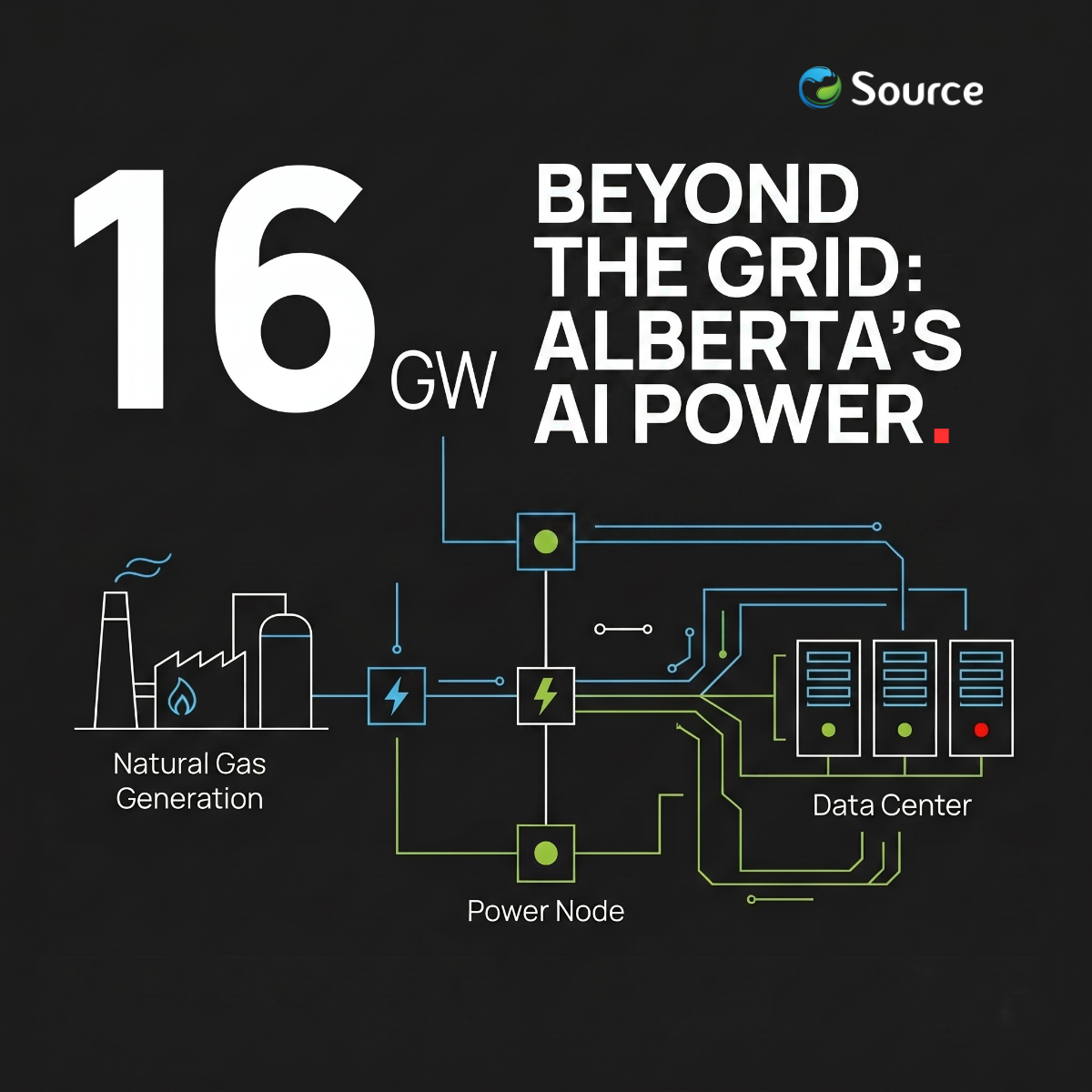
The electricity grid cannot accommodate that growth alone. In 2025, the Alberta Electric System Operator reported that 29 proposed large-load projects were seeking more than 16 gigawatts of grid capacity. Only 1,200 megawatts of additional large loads could initially be accommodated through 2028 without affecting reliability.
Alberta’s emerging answer is effectively: bring your own power.
Developers can pair data centres with dedicated generation, locate near existing natural-gas infrastructure and assume the transmission costs associated with their projects. Meta’s proposed Sturgeon County campus illustrates the model. The more than $13-billion development is expected to receive dedicated power from the planned 932-megawatt Greenlight Electricity Centre.
But the next generation of campuses may need to bring more than generation. They will require integrated systems combining reliable power, cooling, energy storage and responsible water management.
That creates an opening for geothermal. Alberta possesses the drilling expertise, subsurface data, service companies and industrial workforce needed to evaluate geothermal resources alongside gas generation, carbon capture and other technologies. Geothermal can potentially provide firm energy while also supporting efficient thermal management and reducing dependence on water-intensive cooling.
Alberta’s advantage may ultimately be its ability to treat AI infrastructure as an energy system rather than a collection of server buildings. The jurisdictions that integrate computing, power and cooling most effectively will be best positioned to host the next phase of AI growth.