
Andreessen Horowitz has launched a $1.1 billion fund focused on the physical systems required to support the next phase of artificial intelligence growth.
The Machine Age Fund is the venture capital firm’s first investment vehicle dedicated specifically to AI hardware and infrastructure. Its mandate spans chips, memory, networking and storage, as well as data centers, robotics, edge devices and the electrical and cooling systems needed to operate them.
The announcement marks a notable expansion for a16z, a firm closely associated with the capital-light economics of software. Its investment thesis reflects a broader shift across the AI sector: the ability to scale increasingly depends on the availability of physical infrastructure, reliable power and efficient heat rejection.
According to a16z, compute density per rack has increased 28-fold between Nvidia’s H100 and Rubin generations. Rack power requirements, once measured at roughly 5 to 10 kilowatts, have already reached 100 to 250 kilowatts for current systems and could approach one megawatt within three years. At the campus level, development is moving from tens of megawatts toward hundreds of megawatts and, in some cases, gigawatt scale.
Those changes are placing pressure on hardware supply chains accustomed to annual performance improvements of approximately 20 to 30 percent. They are also increasing demand for new approaches to power generation, cooling, materials, electrical infrastructure and data-center design.
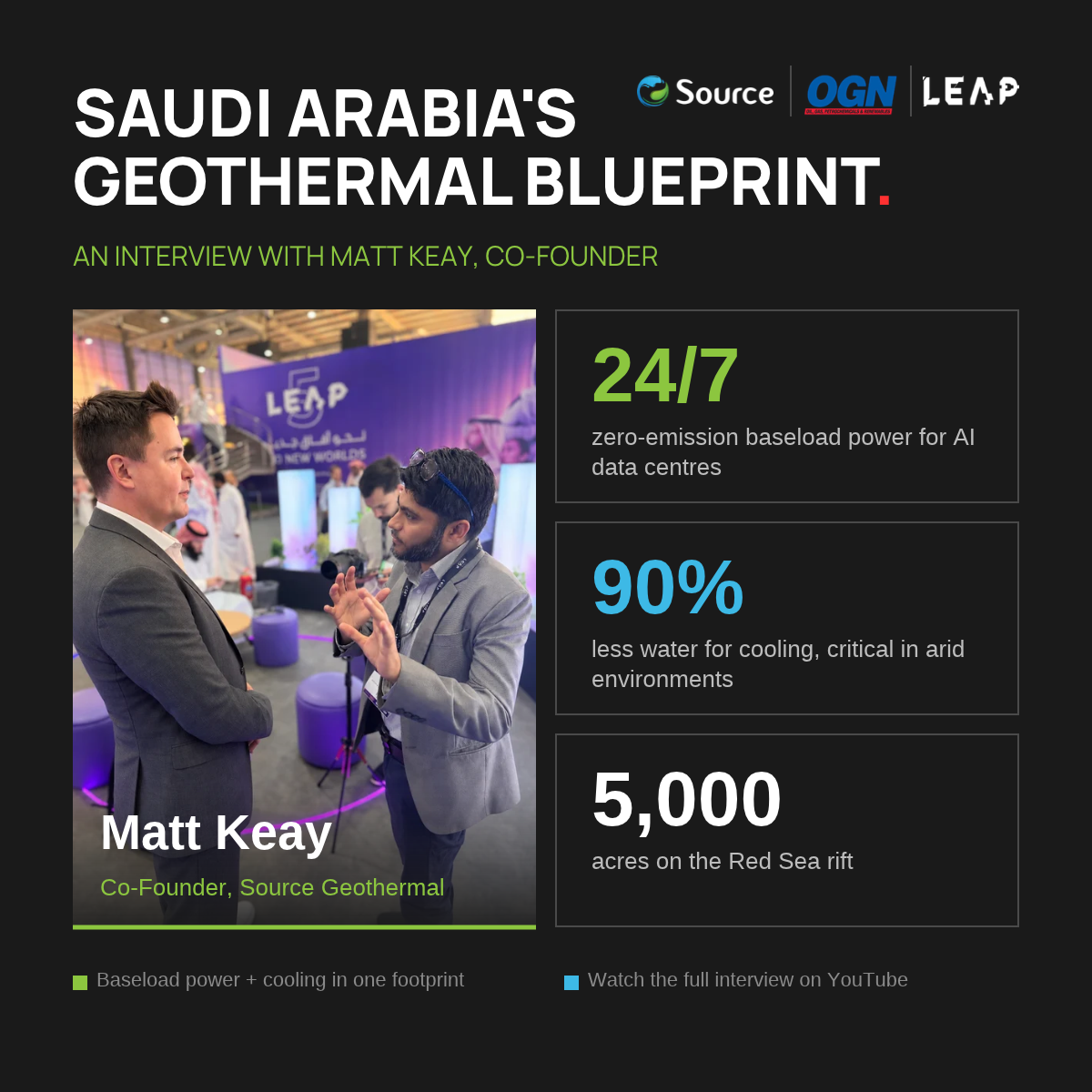
For Source Geothermal, the fund reinforces a central reality of the emerging AI economy: compute cannot scale independently of energy infrastructure. As rack density rises and campuses grow, dependable baseload power, high-efficiency cooling and reduced water consumption become strategic requirements rather than secondary design considerations.
The next phase of AI investment will not be defined by models alone. It will also be determined by who can build, power and cool the physical infrastructure beneath them.
Sources: Andreessen Horowitz and TechCrunch