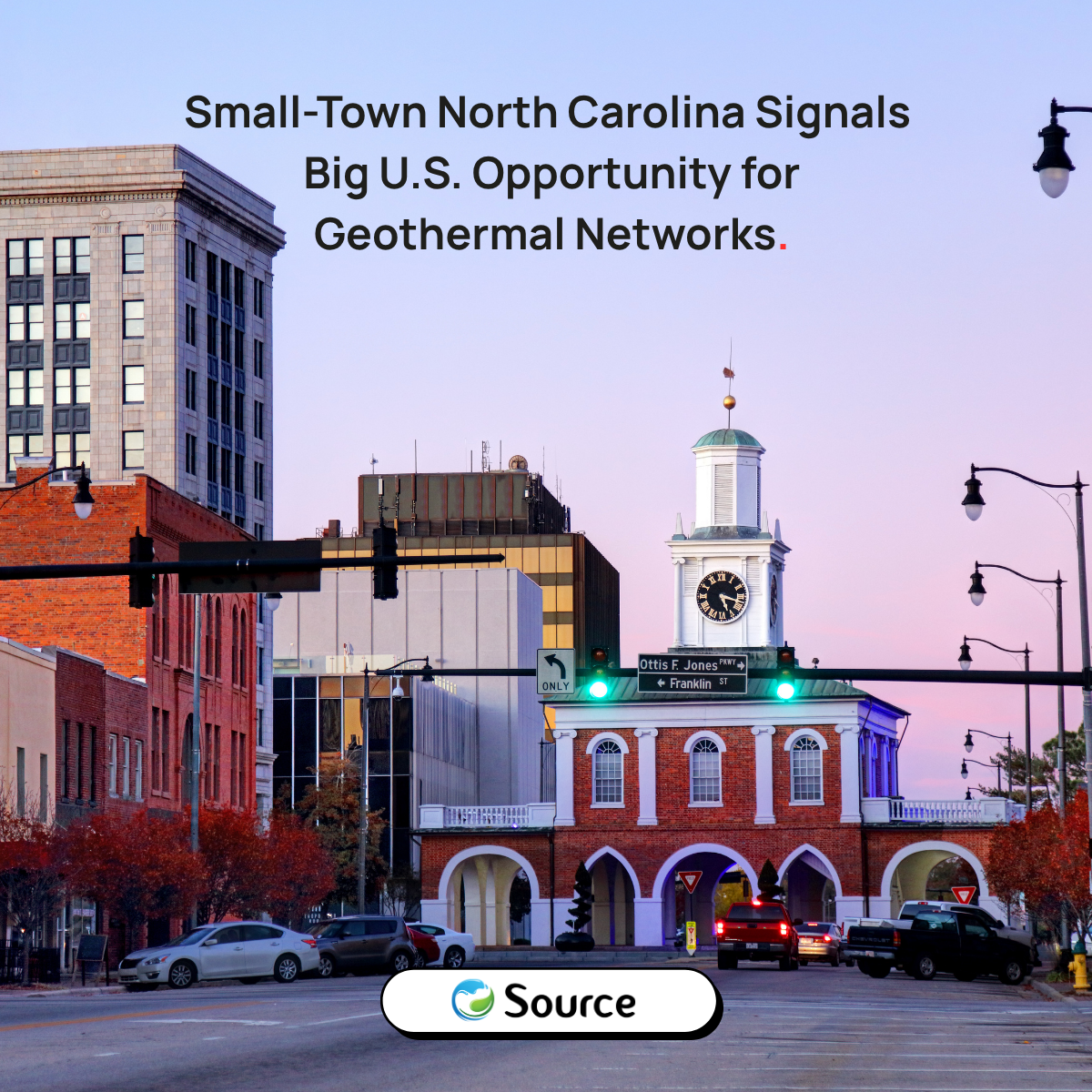
A small but ambitious project in Enfield, North Carolina is reinforcing a major trend Source Geothermal is watching closely: the rise of geothermal not just as power generation, but as community-scale thermal infrastructure. Canary Media reports that Enfield has secured nearly $300,000 in seed funding to advance a shallow geothermal thermal energy network designed to heat, cool, and provide hot water for a new 34-townhome affordable housing development—potentially making it one of the Southeast’s first utility-led deployments of its kind.
For Source Geothermal, this signals growing U.S. market diversification.
While next-generation geothermal often focuses on deep baseload electricity or hyperscale infrastructure, Enfield highlights another critical lane: distributed thermal networks that lower household energy costs, improve resilience, and modernize local infrastructure. The model combines geothermal, grid efficiency, and long-term affordability—especially compelling in underserved or energy-burdened communities.
This aligns with broader U.S. momentum, where geothermal tax incentives remain comparatively resilient and bipartisan support continues to strengthen deployment pathways. For Source, which is actively evaluating U.S. opportunities alongside its Canadian presence, these developments suggest geothermal’s commercial future may include multiple layers—from AI data centre cooling and industrial applications to municipal-scale heating and cooling networks.
As the U.S. geothermal landscape expands, projects like Enfield demonstrate that opportunity may not only emerge from billion-dollar megaprojects—but also from replicable, community-first infrastructure models that can scale region by region. For companies building next-generation geothermal strategy, America’s market may be getting broader, faster, and more practical.