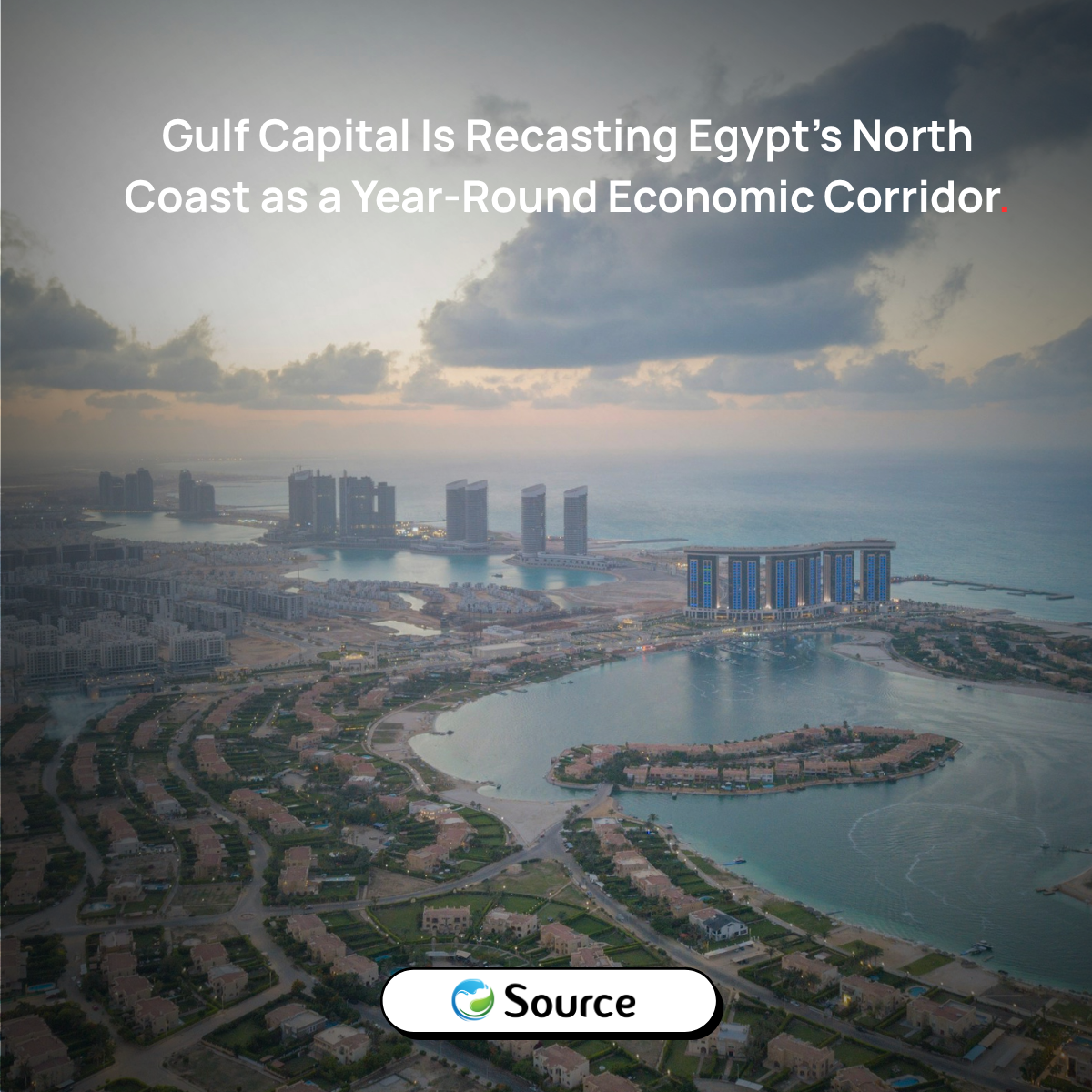
Egypt’s Mediterranean coast is entering a new phase as Gulf-backed developers commit tens of billions of dollars to projects intended to transform a seasonal holiday market into an international, year-round destination.
The largest commitment came from Abu Dhabi in 2024, when it paid $35 billion for development rights covering 40,600 acres at Ras El-Hekma. Master developer Modon Holding envisions a city with tourism facilities, a marina, an airport, investment and free zones, and 310,000 homes serving an eventual population of two million.
Qatari Diar followed in 2025 with a $30 billion plan for Alam Al-Roum, while Egypt’s Talaat Moustafa Group is advancing the $21 billion SouthMED development. Together, the projects signal that Gulf investors increasingly view Egypt’s coast as more than a summer property market.
The Financial Times reports that this shift is already visible at Marassi, Emaar’s established North Coast resort. Non-Egyptian guests, overwhelmingly from Gulf countries, represented 65 percent of hotel occupancy in late August. North Coast property sales surpassed $10.4 billion in 2025, making the region Egypt’s second-largest property investment destination after eastern Cairo.
The more difficult test will be creating lasting economic activity beyond the peak season. That requires reliable air connections, hotels, schools, healthcare, retail, convention facilities and employment, together with infrastructure capable of supporting permanent populations rather than temporary summer demand.
For energy developers, the scale of these plans matters. New cities in hot coastal environments require dependable electricity, efficient cooling, water treatment and infrastructure designed for decades of growth. These systems must be considered early, alongside land use and transportation, rather than added after construction accelerates.
For Source Geothermal, the investment wave illustrates why energy and cooling strategies should be evaluated during master planning. Where subsurface conditions are suitable, geothermal solutions may offer developers another route to resilient, lower-emission power and cooling with reduced pressure on electricity and water networks.
Gulf capital may be initiating the transformation, but long-term success will depend on whether these destinations can operate efficiently, competitively and sustainably throughout the entire year.
Source: Based on reporting by Heba Saleh in the Financial Times.