An illustrative breakdown of artificial intelligence infrastructure spending shows that the largest opportunities extend well beyond land and building construction.
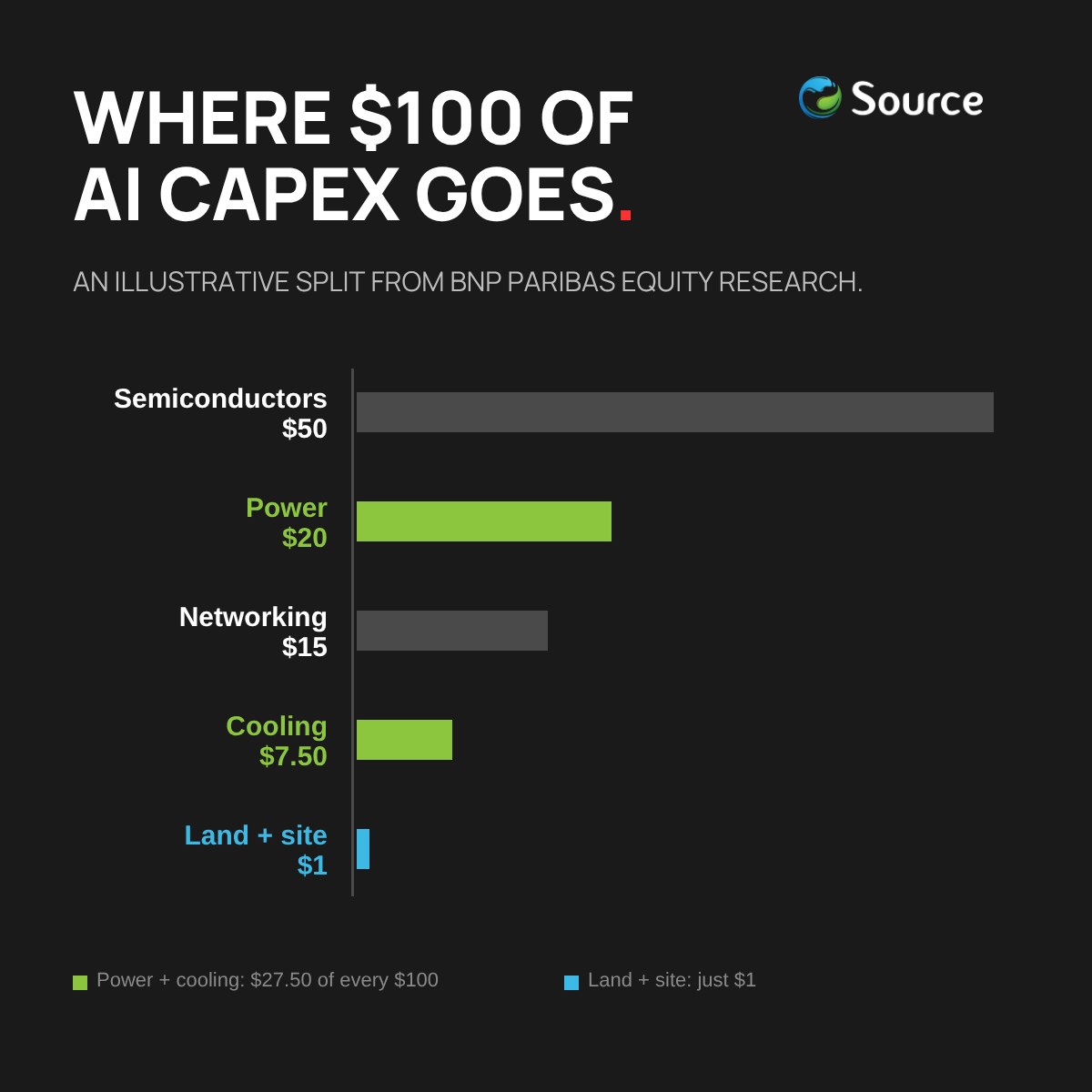
The analysis, attributed to BNP Paribas Equity Research and circulated through Andreessen Horowitz, divides every $100 of AI capital expenditure across semiconductors, networking, power, cooling, and facilities. Semiconductors account for an estimated $50, led by accelerators and memory. Networking represents another $15.
Power infrastructure receives approximately $20, including grid connections or on-site generation, power distribution, and electrical routing. Cooling accounts for another $7.50 through cold plates, coolant distribution units, chillers, cooling towers, and related equipment. By comparison, land and site acquisition represents only $1.
The figures are illustrative rather than a universal project budget. Actual allocations vary by computing density, location, technology, grid access, and development stage. Nevertheless, the comparison highlights where AI infrastructure projects are becoming most technically and financially demanding.
The value of a data-centre site increasingly depends on more than acreage. Developers require sufficient electricity, transmission access, cooling capacity, water strategy, fibre connectivity, permits, and a credible schedule for bringing the full system online. Land without those elements may represent only a small fraction of the completed asset’s value.
For Source Geothermal, the allocation reinforces the importance of treating power and cooling as an integrated system. Geothermal resources may create value not through land ownership alone, but by supporting dependable generation, efficient thermal management, reduced water demand, and long-term operating resilience.
As AI campuses grow in scale and rack density, infrastructure economics will increasingly favour sites that can solve energy and heat before construction begins.