As geothermal energy transitions from early-stage exploration toward scalable infrastructure deployment, improving subsurface certainty has become one of the industry’s most important technical priorities. Drilling risk, reservoir variability, and mineral scaling remain key challenges that influence project economics and long-term operational performance. Emerging modelling approaches that integrate isotope geochemistry with advanced data analytics are beginning to address these uncertainties.
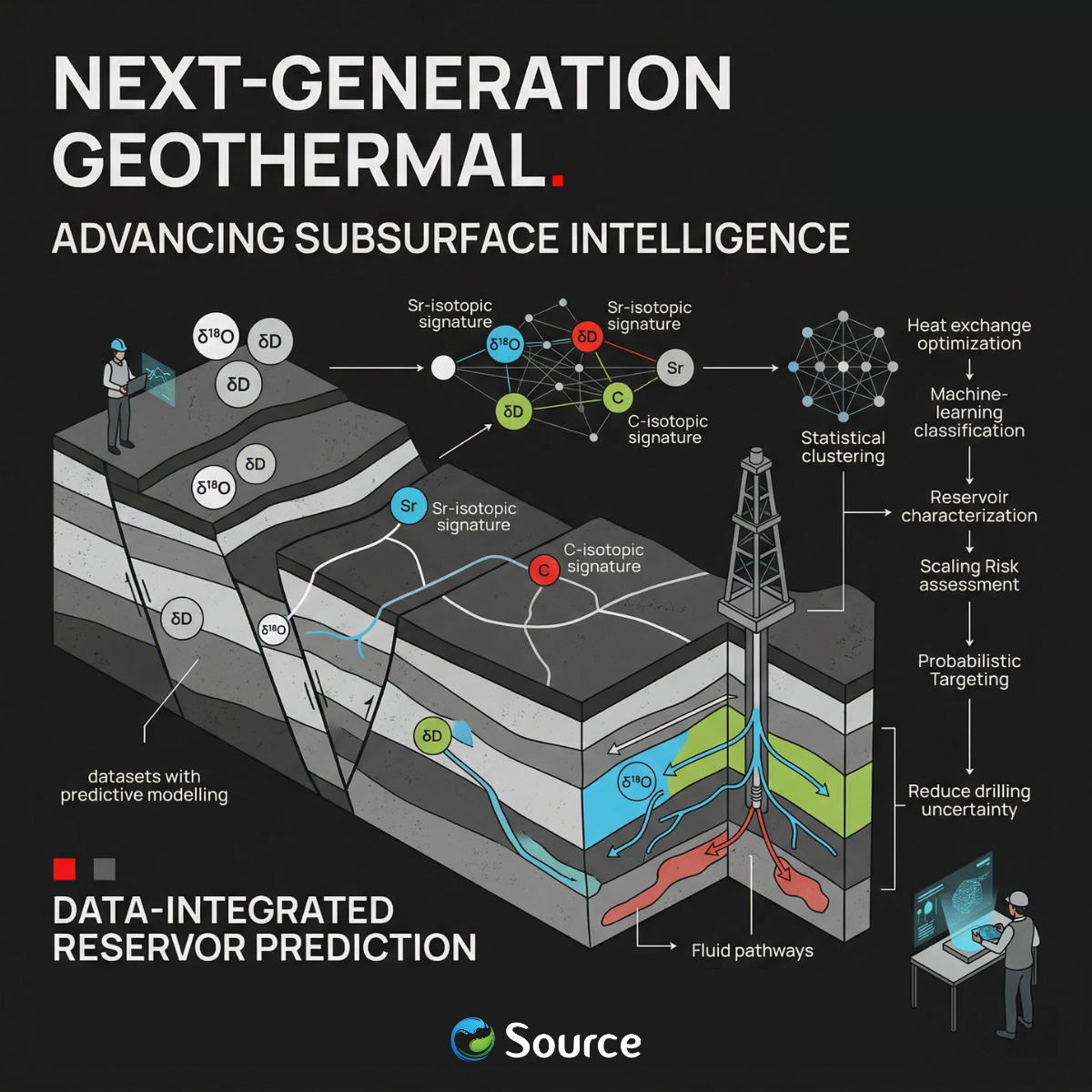
Isotopes naturally present in geothermal fluids act as tracers that record the thermal and geochemical history of subsurface systems. Stable isotopes such as oxygen (δ¹⁸O), hydrogen (δD), carbon, sulfur, and strontium provide insight into fluid origin, circulation depth, water-rock interaction, and reservoir temperature evolution. Traditionally, isotope analysis has been used primarily for post-drilling interpretation. However, new workflows are shifting isotope datasets upstream into predictive modelling environments that support drilling and reservoir planning decisions.
Modern approaches combine multi-isotope datasets with statistical clustering and machine-learning classification techniques to evaluate relationships between fluid chemistry, geological structure, and operational outcomes. By grouping (“clubbing”) geochemical signatures into distinct subsurface regimes, engineers can identify zones associated with optimal heat exchange, fluid recharge pathways, or elevated scaling risk before full development occurs.
This integrated methodology enables several technical advancements. First, isotope-informed models improve reservoir characterization by distinguishing between deep thermal fluids and mixed or recharged systems that may reduce long-term productivity. Second, predictive scaling assessment becomes possible by correlating isotopic signatures with mineral saturation conditions, supporting proactive mitigation strategies. Third, drilling programs can be optimized through probabilistic targeting, reducing uncertainty associated with well placement and completion design.
For closed-loop and enhanced geothermal systems, where performance depends heavily on accurate subsurface understanding, these modelling techniques offer meaningful advantages. Integrating isotope intelligence with thermal simulation, flow modelling, and geomechanical analysis allows developers to move from reactive interpretation toward predictive reservoir management.
The broader implication is a shift in geothermal development philosophy — from exploration driven largely by geological inference toward data-integrated subsurface intelligence. As datasets expand and analytical tools mature, isotope-enabled modelling frameworks are expected to play an increasingly important role in reducing development risk and improving capital efficiency across geothermal projects.
For companies advancing scalable geothermal infrastructure, the integration of geochemical analytics and predictive modelling represents a pathway toward more reliable deployment, longer asset lifetimes, and improved operational certainty. By enhancing understanding of subsurface conditions before and during drilling, geothermal systems can be engineered with greater precision, supporting the industry’s evolution into a dependable foundation of global clean energy infrastructure.