When people talk about artificial intelligence, the conversation usually focuses on chips, algorithms, and compute capacity.
But there is another challenge emerging behind the scenes that may prove just as important: cooling.
Every AI model, data centre, and cloud platform generates heat. As AI workloads become more powerful, that heat increases. While billions of dollars are being invested in processors and power generation, far less attention is being given to how these facilities will be cooled efficiently, reliably, and at scale.
The reality is that cooling is no longer a secondary consideration. It is becoming a strategic infrastructure challenge.
In many regions, cooling systems can account for a significant portion of a data centre’s total energy consumption. In hot climates such as Saudi Arabia, the UAE, and other rapidly growing digital markets, cooling requirements become even more demanding. Water availability, electricity demand, and operating costs are increasingly interconnected.
At the same time, governments and investors are seeking solutions that improve energy security while supporting economic growth and digital transformation.
This creates an opportunity to rethink the relationship between energy and cooling.
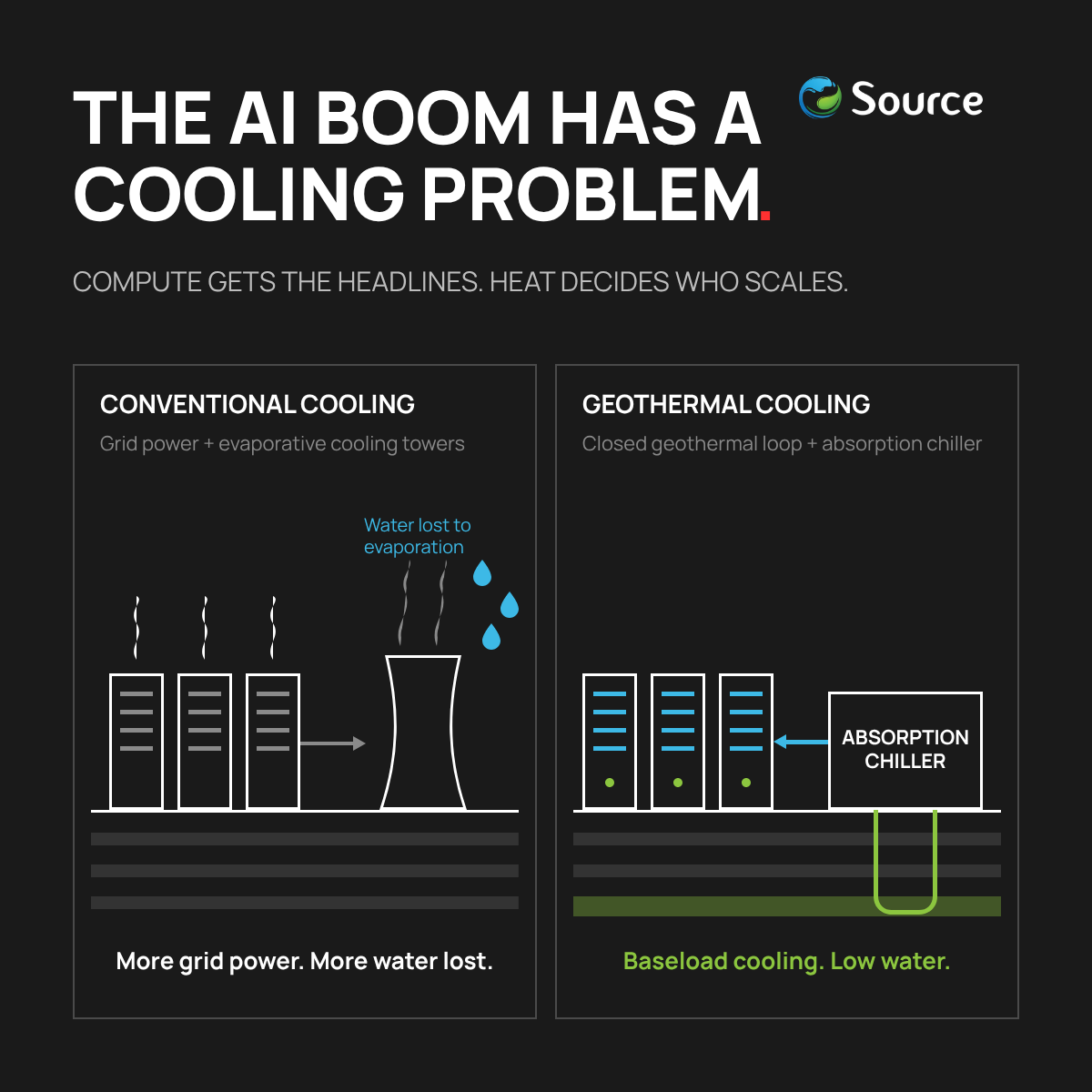
Geothermal-enabled cooling systems offer a different approach. By leveraging stable underground temperatures and geothermal heat resources, these systems can support highly efficient cooling solutions while reducing dependence on traditional energy-intensive cooling methods. When paired with absorption chillers and integrated energy systems, geothermal can provide reliable, baseload cooling infrastructure designed for long-term operation.
As global power demand continues to rise and AI infrastructure expands, the question is no longer simply where data centres will get their electricity.
The next question is how they will stay cool.
The winners in the AI economy may not be those who build the biggest models. They may be those who solve the infrastructure challenges that make those models possible.
Cooling is quickly becoming one of them.