
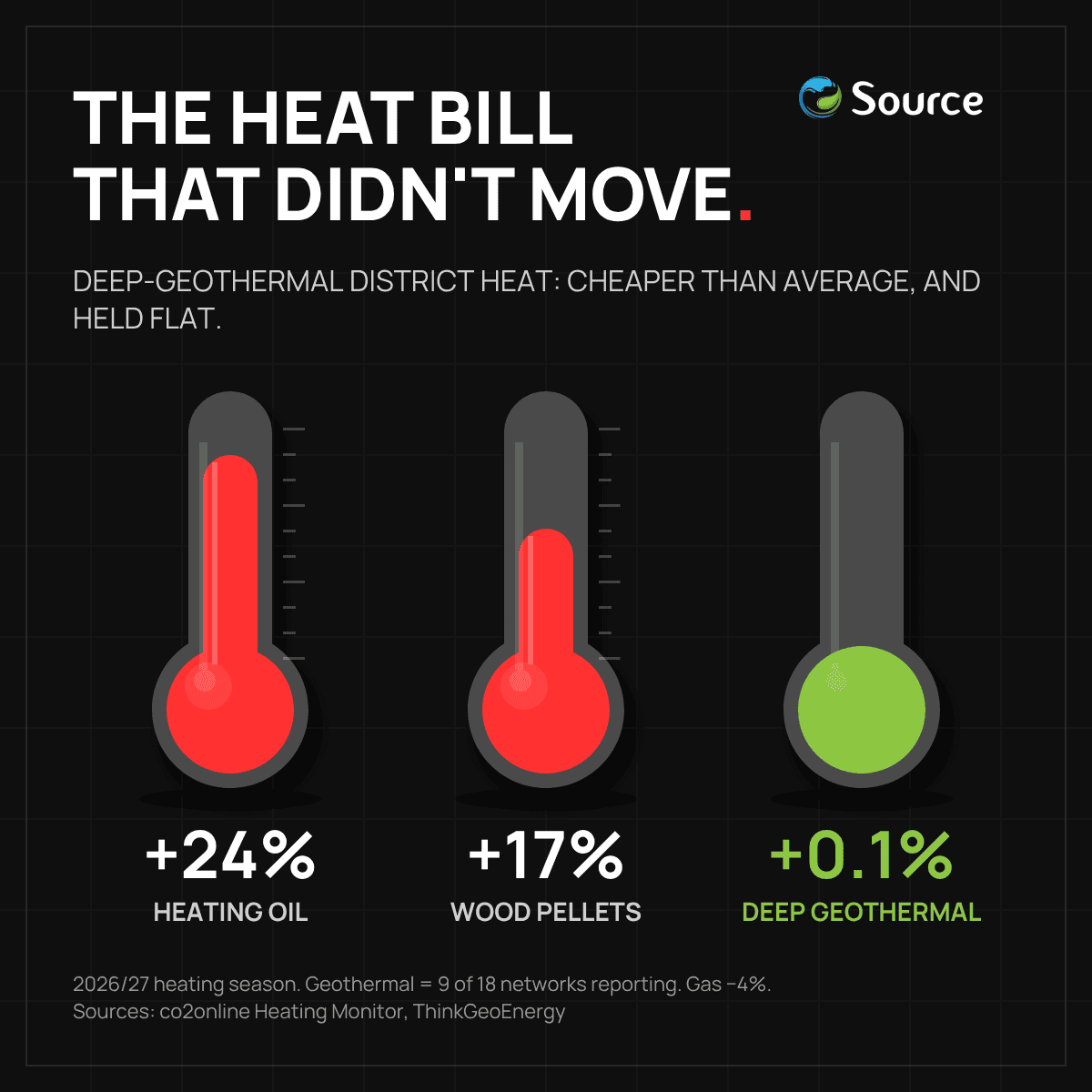
District heating supplied by deep geothermal energy in Germany is about 16 percent cheaper than the national average, and its prices are expected to remain almost unchanged for the 2026/27 heating season, according to a market analysis by Enerchange reported by ThinkGeoEnergy.
The study, conducted for the Praxisforum Tiefengeothermie, examined 24 of the 30 German district or local heating networks fed by deep geothermal plants, across Baden-Württemberg, Bavaria, Brandenburg, Mecklenburg-Vorpommern and Rhineland-Palatinate. For a single-family home using 27,000 kWh a year, the national average across nearly 700 networks is 17.3 cents per kWh. Networks using deep geothermal average 14.5 cents, and 20 of the 24 are cheaper than the national average.
The contrast with fossil heating is sharp. According to co2online’s Heating Monitor 2026, households using heating oil will pay about 24 percent more this year, and pellet users about 17 percent more. Of the 18 geothermal networks tracked for several years, nine had published new prices by early October, with an average change of just 0.1 percent. Erding cut prices by 7.3 percent, roughly €320 a year for a typical household.
Dr. Jochen Schneider, managing director of Enerchange, said that where deep geothermal feeds a network, people pay less and get stable prices, and that no other heating method currently offers both. He also noted the respite from carbon pricing is temporary: Germany’s CO2 price on oil and gas is expected to rise sharply from 2028 when European emissions trading extends to heating.
The principle travels. The same subsurface heat that stabilizes a German heating bill can drive absorption chillers and stable-temperature cooling loops in the Gulf, where heat rejection, not heating, is the dominant thermal cost. Hyperscalers signing ten- and twenty-year contracts for power and cooling want exactly what German municipalities have found: a tariff that does not move with fuel markets or carbon prices.
For Source Geothermal, price stability is the product. The German data shows it is measurable.
Source: ThinkGeoEnergy, Carlo Cariaga, “Market analysis shows district heating from deep geothermal in Germany is 16% cheaper,” October 8, 2026.