Saudi Arabia’s Vision 2030 is fundamentally about diversification: expanding beyond hydrocarbons while leveraging the Kingdom’s world-class subsurface expertise, industrial capacity, and strategic geography to build future-facing infrastructure. Increasingly, geothermal is emerging as a logical extension of that strategy.
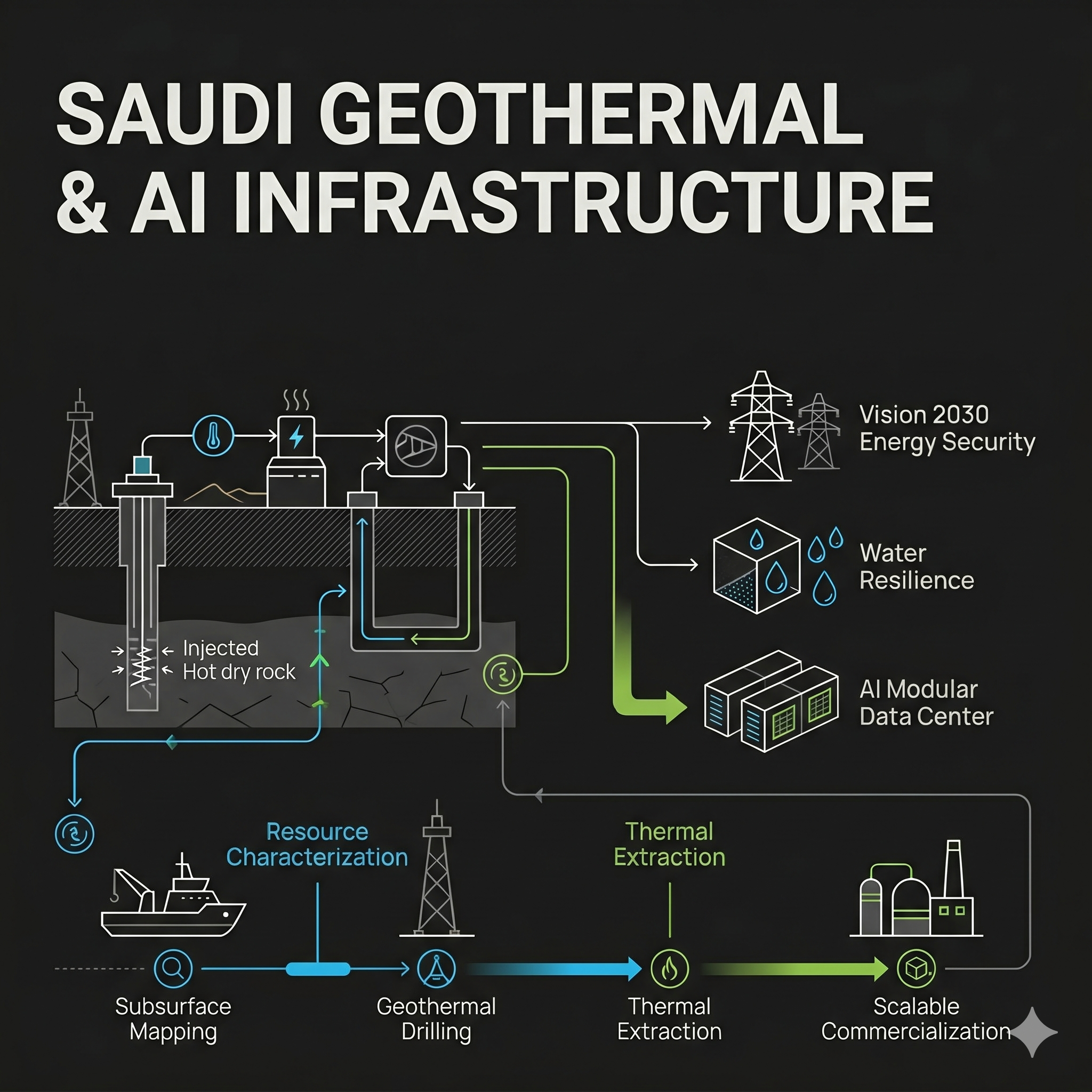
Recent Saudi geothermal pilots, startup momentum, and cooling-focused innovation suggest the Kingdom is beginning to explore a major opportunity: not simply geothermal power, but geothermal as integrated infrastructure for energy, cooling, water conservation, and industrial resilience.
This matters because Saudi Arabia sits at the intersection of three defining pressures: rising electricity demand, extreme heat, and water scarcity. At the same time, Vision 2030 seeks to expand AI, digital infrastructure, industrial competitiveness, and sovereign capability.
Source Geothermal’s Saudi-focused positioning frames this clearly: geothermal can become “energy integrated, climate-optimized cooling, and AI-ready infrastructure,” particularly in extreme climates where cooling becomes a strategic burden rather than a utility function. In practical terms, this means geothermal is not just electricity—it can potentially support absorption chillers, district cooling, data centers, and industrial systems while dramatically reducing water intensity.
This is where Saudi Arabia may hold unique advantages.
The Kingdom’s oil and gas workforce, drilling supply chains, and subsurface engineering capabilities are globally recognized. Rather than replacing this expertise, geothermal offers a pathway to redeploy and expand it. As Source’s internal framework notes, geothermal can “repurpose hydrocarbon expertise while building a sovereign talent pipeline to power the next era of growth.”
For Saudi Arabia, this creates strategic alignment across:
- Water conservation
- Energy efficiency
- Climate resilience
- Workforce transition
- Domestic industrial capacity
The Red Sea corridor, western Saudi geology, and large-scale giga-project environments may offer compelling early-stage opportunities, particularly where cooling demand and energy security converge.
But commercialization should follow disciplined stage gates.
Stage 1: Pre-Feasibility Study (Pre-FS)
Assess geology, heat gradients, cooling demand, land integration, workforce needs, and techno-economic viability across multiple geothermal pathways (closed-loop, EGS, hybrid systems, absorption cooling).
Stage 2: Full Feasibility Study (FS)
Detailed subsurface modelling, CAPEX/OPEX benchmarking, infrastructure integration, regulatory alignment, and pilot design.
Stage 3: FEED (Front-End Engineering and Design)
Engineering architecture, procurement strategy, workforce deployment, EPC frameworks, and phased execution.
This stage-gated model reduces risk while building Saudi internal knowledge, allowing the Kingdom to evaluate geothermal not as speculation—but as financeable infrastructure.
As AI infrastructure and hyperscale computing expand globally, Saudi Arabia has an opportunity to think beyond imported models. Cooling can become a thermal system, not merely an electrical burden. Source’s framework positions geothermal and absorption chillers as a potential pathway to lower water use, improve resilience, and align directly with Vision 2030 priorities around sustainability and economic modernization.
Saudi Arabia’s geothermal future is not guaranteed—but the logic is increasingly compelling.
The Kingdom already mastered subsurface energy once.
Vision 2030 may offer the opportunity to do it again—this time for the AI era.