Project: Development of the Woodford Shale Asset, Multi-Well Pad Drilling
Challenge: Drill three ~10,000 ft laterals in a geologically complex area with high fault density and lateral stratigraphic changes (erosional top and limestone stringers). Maintain >90% drilling efficiency while avoiding costly exits from a 30 ft target window. A key performance indicator (KPI) is minimizing wellbore tortuosity to ensure successful completion operations.
The Focused Model: A 1:1 Rig-to-Geosteerer Ratio
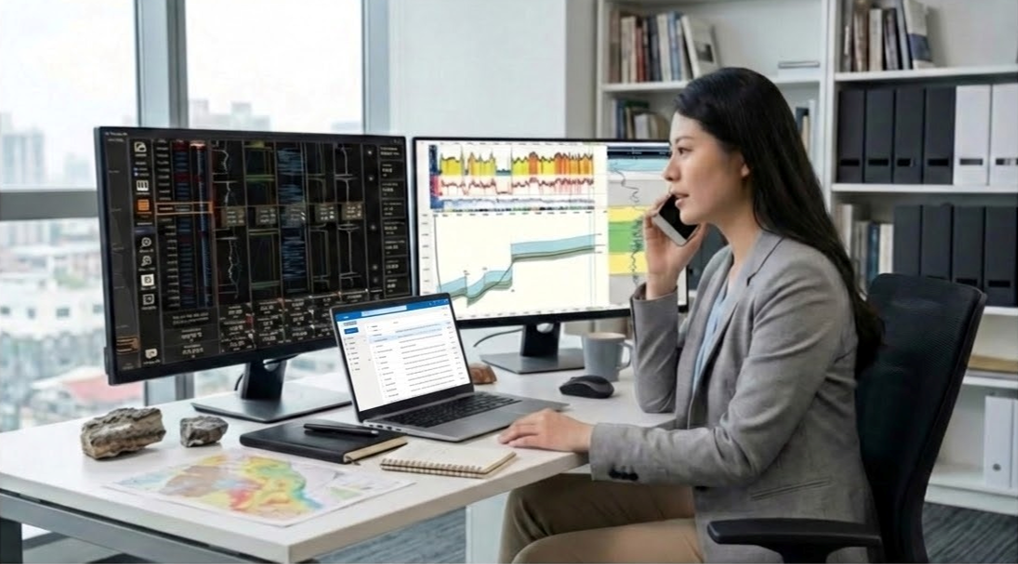
For this high-stakes project, the operator mandated a one, two-person geosteering geologist team per one active drilling rig model. This was not a luxury but a risk-mitigation and value-creation strategy. Geosteerer “Pam Beasly” was assigned exclusively to “Rig 12” for night time geosteering operations for the duration of its lateral.
Monitoring & Communication in Action: A Real-Time Narrative
10:45 PM – Proactive Target Adjustment:
Pam monitors the Live Rig View (Pason). While the WITSML gamma in her geosteering platform shows the well is in zone, she observes a steady, subtle increase in continuous inclination while rotating. The bit is naturally building angle. Concurrently, ROP has slightly increased, and gas shows a corresponding uptick. Pam interprets this as the bit approaching a slightly up-dip section with higher TOC. Using her understanding of lag depth (65 ft behind bit), she predicts the gamma will show this climb in ~60 ft. Instead of waiting, she contacts the DD directly: “Jim Halpert, I see us building naturally on continuous Inc. I’m going to proactively lower the target line by 5 ft TVD to keep us centered. Plan to make that change at the bottom of your current stand.” This direct, timed communication allows a smooth transition without an unplanned slide, minimizing tortuosity and reducing overall rig time.
1:15 AM – Early Fault Zone Detection & Hazard Avoidance:
During routine rotation, Pam’s eyes dart across the live curves. She notes a sudden, sharp spike in torque, followed by a drop in ROP. Differential pressure fluctuates, and gas readings become erratic, despite mud weight in/out showing minor changes. This combination, seen instantly on Live Rig View, tells a story the lagged gamma cannot. She immediately recognizes the signature of a fault zone or highly fractured interval.
- Action: She calls the DD urgently: “Jim, stop rotating. We’ve likely hit a fault zone. I see torque spikes and erratic gas. Hold parameters, let’s circulate and monitor pressures and gas carefully before proceeding.”
- Result: The rig crew circulates, confirms well stability, and slowly proceeds. Pam’s instantaneous diagnosis, 15 minutes before any gamma anomaly, prevented potential issues like lost circulation, a gas influx, or damaged drill string. The wellbore crossed the 16-ft fault zone with minimal issues.
5:15 AM – Utilizing All Data for Precision Steering:
Pam is in a section with poor gamma contrast. GR curve matching alone is ineffective. She synthesizes multiple data streams:
- RPM and Tool Face: She watches RPM to confirm slide cycles and uses tool face orientation to predict build/drop rates.
- ROP/Gas Relationship: A simultaneous drop in both suggests a less organic, possibly harder limestone bench.
- Up/Down Gamma: Available on this run, it clearly shows the wellbore is drilling down-section with cooler gamma below, confirming her suspicion from the continuous inclination trend and ROP/Gas data.
- Mud Weight/ROP Context: She notes the current mud weight is 1 ppg higher than an offset well, mentally adjusting her ROP expectations for formation strength.
With this integrated analysis, she confidently instructs a slide to correct the trajectory, staying in zone despite the ambiguous GR. This prevents a slow, unnoticed exit.
Key Outcomes of the dedicated 1:1 Ratio:
- Superior Wellbore Quality: By using continuous inclination and torque trends as early indicators, Pam optimized target changes during rotation and minimized reactive slides. Direct communication with the DD allowed perfect timing of steering changes. The resultant smooth wellbore showed a 32% reduction in torque drag in the later lateral section compared to offsets drilled under a higher rig-geosteerer ratio.
- Disaster Prevention: The early fault detection incident alone saved an estimated 18-24 hours of non-productive time (NPT) and avoided a potential well control incident.
- Enhanced Geological Insight: Freed from the frantic task-switching of monitoring multiple rigs, Pam had time to continuously refine her geological model, integrate offset data, and evaluate lateral heterogeneity. This led to better-informed decisions, not just reactive ones.
- Optimal Well Placement: The lateral achieved 76% target contact in the core sweet spot, directly attributable to the ability to focus on and interpret the full suite of real-time data, not just the lagging GR curve or survey emails. This well had large faults, making 100% target contact unattainable.
Conclusion:
This case study demonstrates that a focused 1:1 rig-to-geosteerer ratio is a critical operational discipline, not an overhead cost. It enables the essential, proactive practices of:
- True real-time monitoring of Live Rig data for early warnings of hazards (faults, exits) 5-15 minutes ahead of lagged LWD data, 30-45 minutes ahead of survey email.
- Integrated analysis of drilling parameters (ROP, torque, gas, inclination, up/down GR) as primary formation evaluation tools.
- Effective, direct communication with DDs to execute precise steering and minimize tortuosity. For multi-million dollar horizontal wells, this focused oversight is a proven method to reduce risk, enhance efficiency, and maximize asset value, ensuring the geosteerer can fulfill their role as the well’s real-time geomechanical detective and navigator.