Saudi Arabia’s investment landscape extends beyond a single sovereign fund, connecting ministries, listed companies, development funds, banks, strategic holding groups, and project-specific operating companies.
An ecosystem map circulating among regional investors places the Public Investment Fund within a broader system that includes government bodies, the Capital Market Authority, sector-focused funds, major listed groups, and Vision 2030 development platforms. Organizations shown include Saudi Aramco, SABIC, Ma’aden, stc, Saudi National Bank, Riyad Bank, Acwa, Diriyah Company, Qiddiya, NEOM, Red Sea Global, ROSHN, Saudi Arabian Military Industries, and Jeddah Central Development Company.
The graphic should not be read as a formal ownership chart. Some entities are directly controlled by PIF, some are portfolio investments, and others operate elsewhere within the Kingdom’s public and private capital system. Its value is in demonstrating how policy, capital, infrastructure, and project delivery are connected across Saudi Arabia.
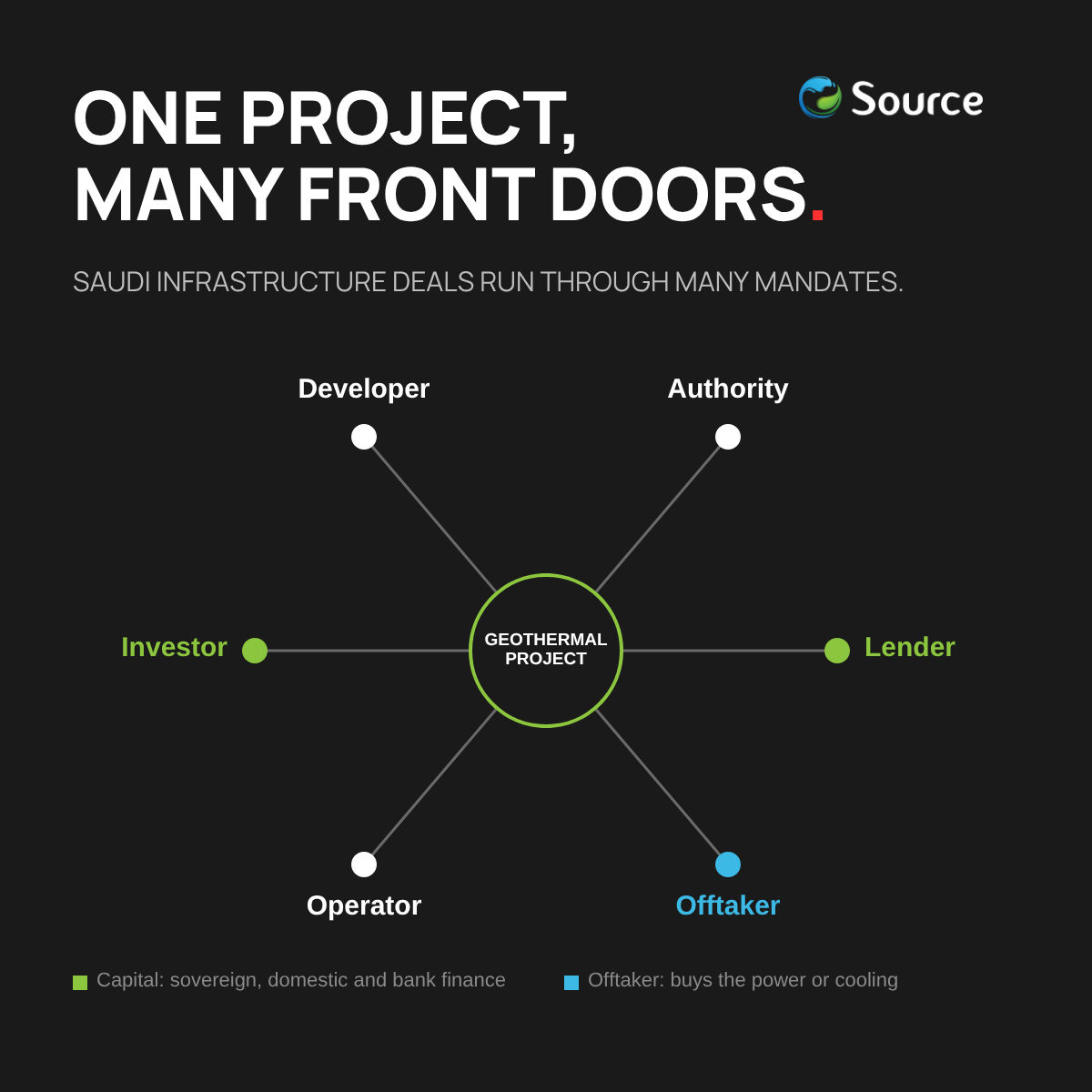
For international companies, that structure changes market-entry strategy. A major infrastructure proposal may involve a project developer, a government authority, an operating partner, a domestic investor, and a financing institution, each with different mandates and approval processes. Securing interest from one organization does not automatically secure alignment across the wider system.
For Source Geothermal, this underscores the importance of identifying the correct route for each project. A geothermal power and cooling opportunity could connect with sovereign investment priorities, utility planning, real-estate development, industrial policy, water strategy, or AI infrastructure.
The strongest proposals will therefore link a clear project-level business case to national objectives while defining who develops, funds, owns, operates, and purchases the resulting energy or cooling service.