As Canada electrifies transportation, buildings, and industry, one of the biggest challenges for grid operators is managing peak electricity demand.
Peak demand — the hours when electricity use is highest — determines how much generation and grid infrastructure must be built. Even if these peaks occur only a few hours each year, utilities must maintain enough capacity to meet them.
Research presented during the Clean Energy Canada webinar “Unlocking DER Potential in Canada” suggests distributed energy resources (DERs) could significantly reduce these peaks.
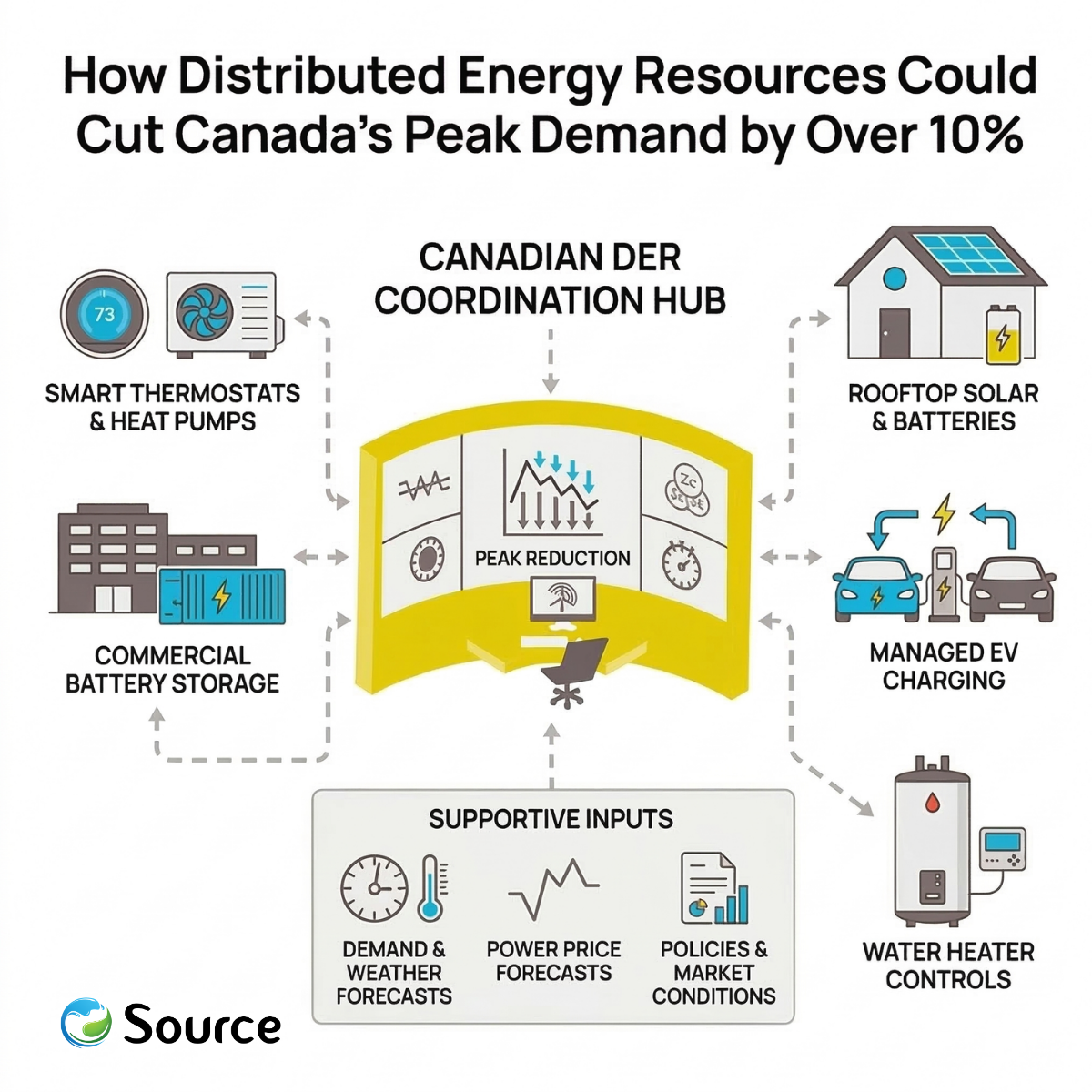
Under the right policies and market conditions, DERs could lower peak electricity demand by more than 10 percent.
Understanding the Peak Demand Challenge
Utilities often analyze a representative peak day to assess the maximum strain on the grid. Demand spikes during extreme weather, increased heating or cooling loads, industrial activity, and higher residential electricity use.
Traditionally, utilities respond by building new generation or expanding grid infrastructure. But DERs offer another option: flexibility.
Technologies such as smart thermostats, heat pumps, managed EV charging, water heater controls, and battery storage can shift electricity use to different times of day. When coordinated through demand response programs or virtual power plants (VPPs), these distributed technologies can reduce peak demand without building new infrastructure.
Three Possible Futures for DER Impact
The Dunsky analysis presented during the webinar modeled DER potential across three scenarios.
Reference Scenario (Business as Usual)
Under current policies, DERs could reduce peak demand by approximately 670 MW, equal to about 4.2% of peak demand.
Accelerated Electrification Scenario
With faster electrification and greater adoption of flexible technologies, peak reductions could reach 930 MW, or roughly 5.5% of peak demand.
DER-Centric Scenario
In a future where distributed energy resources are actively prioritized as a grid resource, peak demand reductions could reach 1,760 MW — about 10.4% of peak demand.
At this scale, DERs could significantly reduce the need for expensive new generation and transmission infrastructure.
Why Distributed Energy Matters
DERs reduce peak demand by shifting electricity consumption to lower-demand hours. For example, EVs can charge overnight, smart thermostats can pre-cool buildings earlier in the day, and batteries can discharge during peak periods.
Individually, each device has a small impact. But when thousands or millions of devices are coordinated together, they become a powerful grid resource.
Virtual power plants enable this coordination, allowing distributed devices across homes and businesses to operate like a single flexible power plant.
Implications for Canada’s Grid
Canada is entering a period of rapid electricity demand growth driven by electrified transportation, building heating, industrial decarbonization, and data centre expansion.
Meeting this demand using traditional infrastructure alone would require massive investment in generation and transmission.
Distributed energy resources offer a complementary strategy. By reducing peak demand and improving system flexibility, DERs could help utilities manage growth while avoiding some of the most expensive grid upgrades.