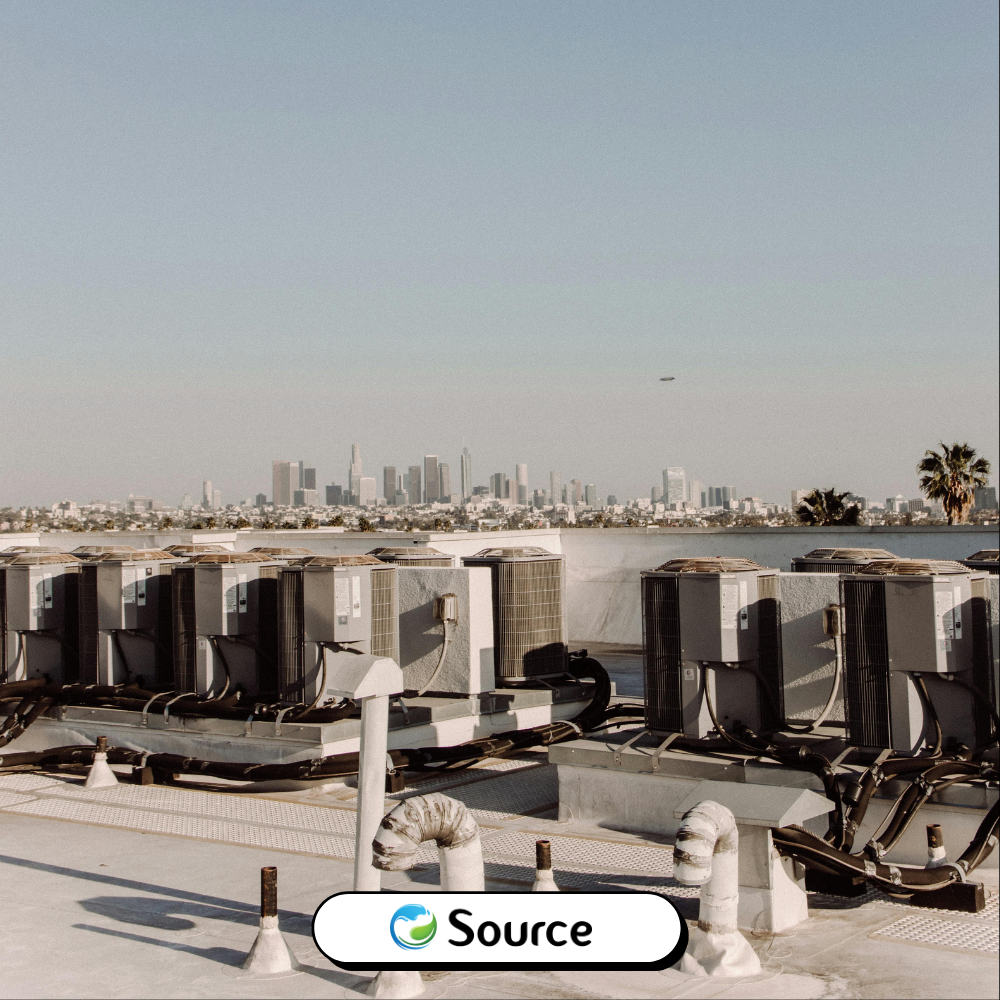
Air conditioning demand surges as cities heat up and prosper. Millions of rooftop chillers threaten grid stability and refrigerant emissions. District cooling centralizes the solution. Large plants chill water centrally then pipe it to building clusters, slashing equipment count and enabling technologies like seawater free cooling or massive ice tanks.
Project Drawdown profiles this approach as a “Keep Watching” climate solution with strong potential. Their analysis flags cooling as one of buildings’ fastest growing emission sources, already approaching 1 gigatonne CO2 equivalent annually. District systems cut that trajectory by concentrating high efficiency chillers, optimizing part load performance and shifting electric demand via storage.
Drawdown notes deployment barriers remain significant. Upfront pipe infrastructure costs and coordination complexity slow adoption versus standalone units. Data gaps also limit full modeling. Still, the framework sees clear advantages in dense districts, airports and campuses where anchor loads justify networks. Free cooling from deep lakes or oceans slashes runtime where geography cooperates.
The assessment positions district cooling alongside district heating improvements as paired infrastructure for urban decarbonization. Both leverage scale to integrate low carbon inputs, whether heat pumps for winter or chillers for summer. Drawdown emphasizes early urban planning as critical. Projects baked into masterplans from day one outperform retrofits.
For cities and real estate funds, Drawdown’s signal aligns with rising heat risk. Centralized cooling delivers comfort plus grid relief and lower lifecycle emissions. As standalone AC saturates suburbs, district networks carve the efficient path for high rise cores and institutional clusters. Watch list status reflects maturing economics rather than unproven promise.
Reference