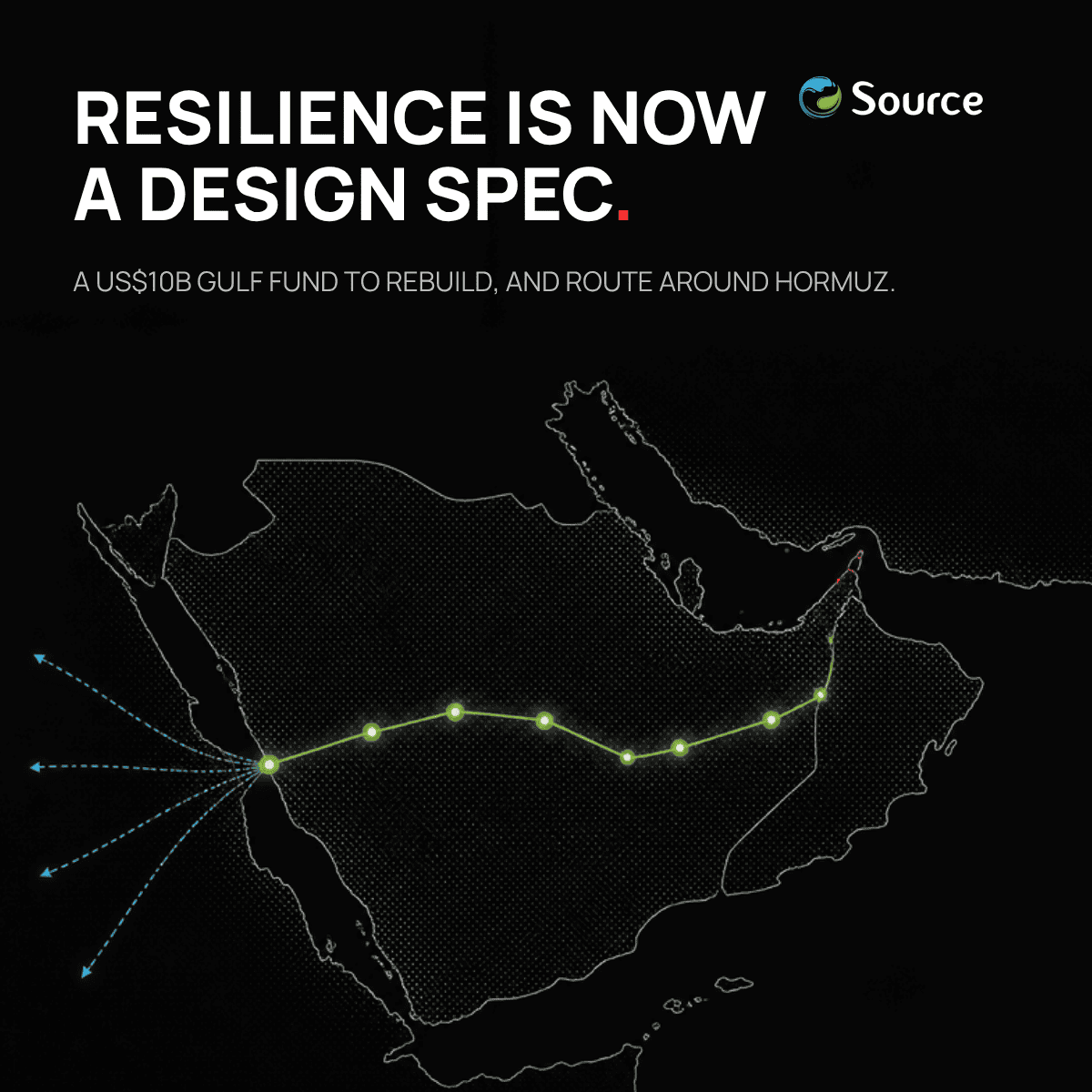
U.S. President Donald Trump has proposed a US$10 billion fund to rebuild war-damaged energy infrastructure in the Gulf and develop oil and gas export routes that bypass the Strait of Hormuz, according to a Wall Street Journal report cited by Oil & Gas News.
The proposed Partnership for Allied Trust and Construction, or PACT, would bring together the United States, Saudi Arabia, the UAE, Qatar, Bahrain, Kuwait, Oman, Iraq and Jordan. Washington would provide US$5 billion, matched by US$5 billion from regional partners. The fund would be managed by the U.S. Development Finance Corporation and target repairs to pipelines, refineries and other energy facilities while supporting alternative export corridors. Discussions remain ongoing and terms could change.
The plan follows months of conflict with Iran that exposed the vulnerability of Gulf energy infrastructure and the region’s reliance on a single shipping chokepoint. Brent crude has eased to around US$98 a barrel as Saudi Arabia restores its East-West pipeline, which can move roughly 7 million barrels per day, although initial throughput remains below full capacity.
The initiative matters beyond hydrocarbons. The Gulf’s next wave of infrastructure is digital: sovereign cloud regions, AI zones and hyperscale data centres that must operate continuously regardless of what happens at sea. Those facilities depend on power and cooling systems that are just as exposed to disruption as pipelines and refineries.
For Source Geothermal, the PACT proposal signals that resilience is now a design requirement, not a preference. Geothermal infrastructure is inherently local and hardened. It draws on heat beneath the site, does not depend on fuel deliveries or long transmission corridors, and can supply both baseload power and stable-temperature cooling for critical facilities. In a region now pricing the cost of single points of failure, distributed subsurface energy offers a different kind of security.
As the Gulf rebuilds its energy backbone, the opportunity is to build the next layer, the digital refineries that will process the region’s data, on infrastructure designed from the outset to withstand disruption.
Source: Oil & Gas News, “$10bn fund to rebuild Gulf energy infrastructure,” citing The Wall Street Journal, October 1, 2026.