
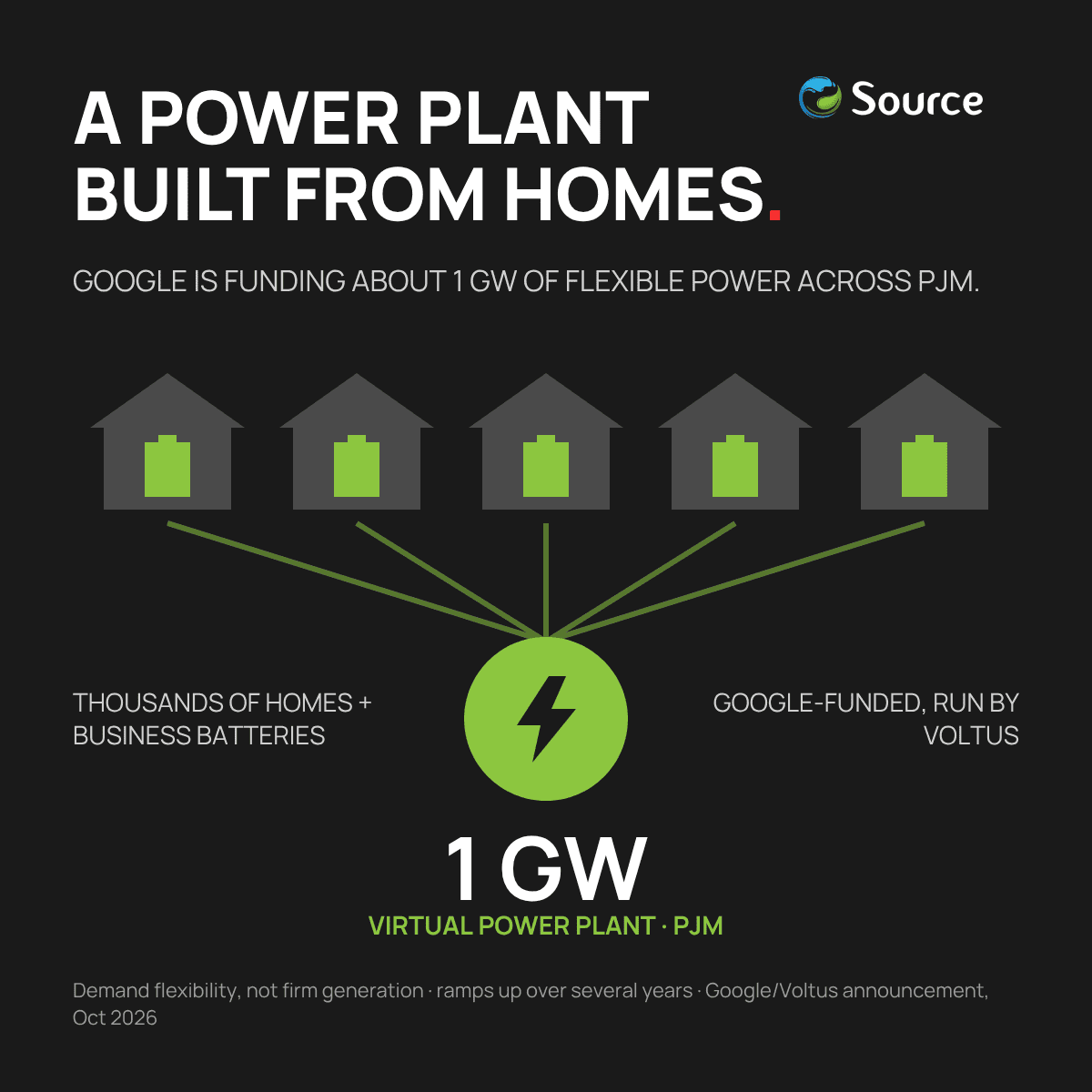
Google and Voltus have announced Phase 2 of a partnership to deliver large-scale grid flexibility in PJM Interconnection, the largest grid operator in the United States. The agreement adds 1 GW of flexible capacity through a virtual power plant funded by Google and aggregated by Voltus using distributed assets such as batteries.
The expansion follows a Phase 1 agreement announced in June, under which Google funded 100 MW of flexible capacity annually. That tranche was fully subscribed quickly, providing the proof point the two companies say is needed to scale.
The model gives hyperscalers a route around long interconnection queues. Rather than curtailing compute, as conventional flexibility frameworks have required, Google pays for flexibility elsewhere on the grid and brings its facilities online faster.
PJM is currently short by an estimated 6.8 GW. New behind-the-meter gas turbines may not be available until 2032, and nuclear uprates are expected between 2028 and 2034. By comparison, the battery industry expects to deploy 400 MW at homes and businesses in 2027 alone under the Voltus–Google contract. Bilateral contracts for new gas imply costs of roughly $400,000 per MW-year; distributed batteries are both faster and cheaper.
Grid strain is already visible. PJM dispatched its Emergency Load Response Program twice in a single week in October, bringing the total to 15 dispatches over two years, compared with eight between 2015 and 2024.
The structure is also designed to address local opposition, which blocked or stalled an estimated $156 billion in data centre projects last year. Participating households and businesses receive batteries at little or no cost through developer partners, are expected to save about 20 percent on electricity bills through demand response payments, and gain backup power. Distributed storage can also help utilities defer ratepayer-funded distribution upgrades.
Jigar Shah, who reported the deal in his Accelerating Climate Wealth newsletter, argues the model reframes data centres and communities as partners rather than rivals for scarce power, and suggests a Phase 3 could reach 10 GW.
For Source Geothermal, the announcement confirms that hyperscalers are now willing to fund energy infrastructure directly in exchange for speed to power. Demand-side flexibility closes a near-term gap, but it shifts load rather than adding firm, 24/7 generation. As AI workloads grow, operators will need both: distributed flexibility on the grid and dependable on-site power and cooling at the facility. Geothermal supplies the latter, and the capital now flowing to grid flexibility signals that the market is ready to pay for it.
Source: Based on reporting by Jigar Shah, “Bring Your Own Capacity: How Voltus and Google Are Rewriting the Data Center Playbook,” Accelerating Climate Wealth, October 23, 2026.