Saudi Arabia’s AI ambitions should be measured by contracted infrastructure, not announcement volume, according to Taranis Capital.
The investment firm highlights HUMAIN’s target of 1.9 gigawatts of data-centre capacity by 2030, alongside 211 sites offering access to 14 gigawatts of power. HUMAIN has relationships with NVIDIA, AMD, AWS, Cisco and Qualcomm.
Taranis argues that access to land and power represents a development opportunity—not delivered capacity. Public disclosures include chip allocations, memoranda and construction announcements, but provide limited detail about grid interconnections, generation contracts, power-purchase agreements and customer commitments.
That distinction matters because AI training clusters operate near full capacity continuously. Solar power can contribute, but intermittent generation requires storage or dependable backup for continuous computing loads.
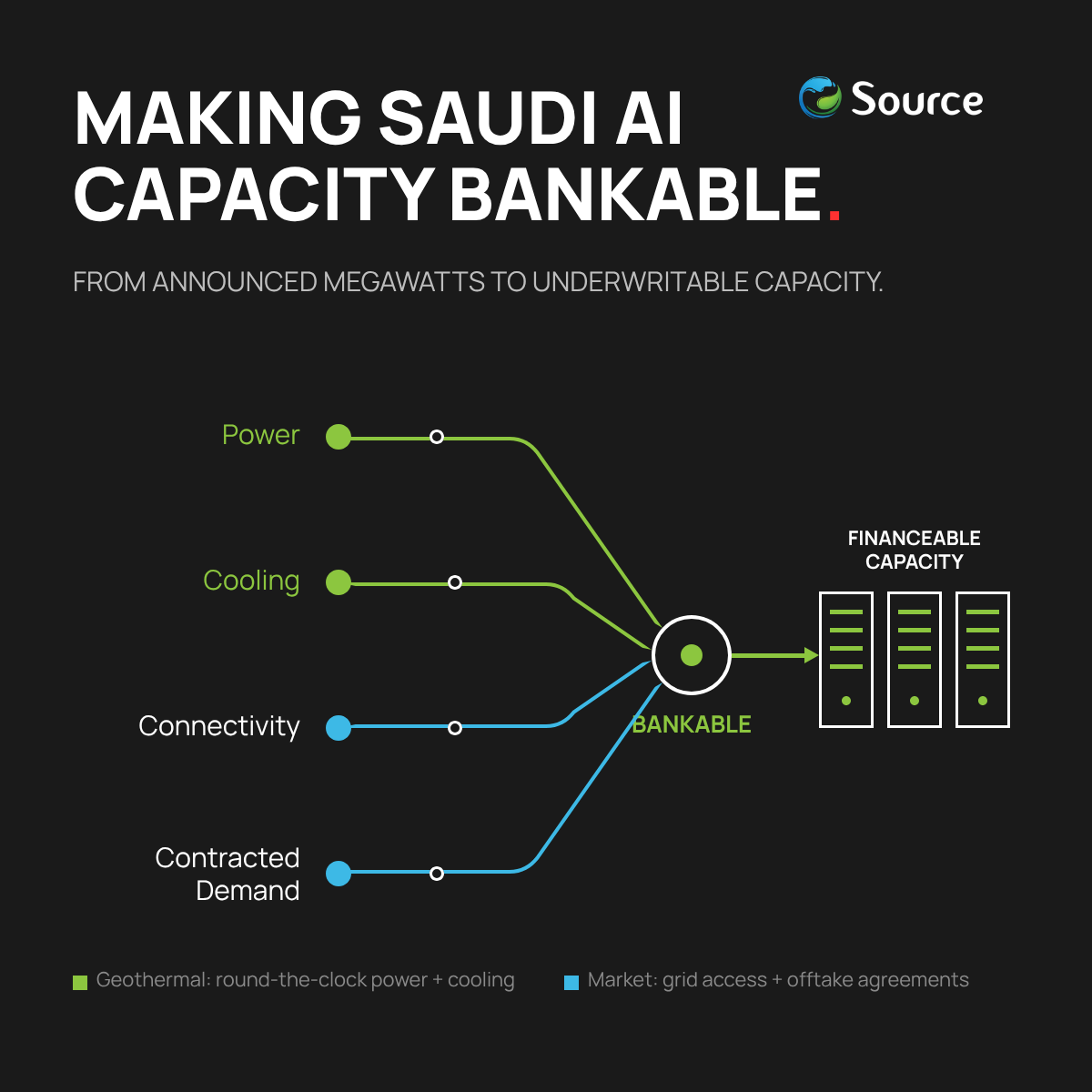
This is where geothermal infrastructure could strengthen the Kingdom’s investment case. Geothermal can provide round-the-clock power while supporting cooling through stable subsurface temperatures. Combined with bankable offtake agreements, it could help transform megawatts into financeable data-centre capacity.
Taranis notes that international customers will increasingly demand disclosure of the carbon and water intensity associated with their computing services.
Saudi Arabia has the capital, land and ambition to build at scale. The test is assembling power, cooling, connectivity and contracted demand into infrastructure investors can underwrite.
Source: Taranis Capital, “LEAP 2026—Reading Saudi Arabia’s AI Build-Out from the Capital Side,” August 31, 2026.