The geothermal industry has made enormous progress over the past decade.
Drilling technology has improved. Subsurface modelling has become more sophisticated. Data analytics, artificial intelligence, and lessons learned from the oil and gas sector have helped reduce technical risk and improve project performance.
The technology is advancing.
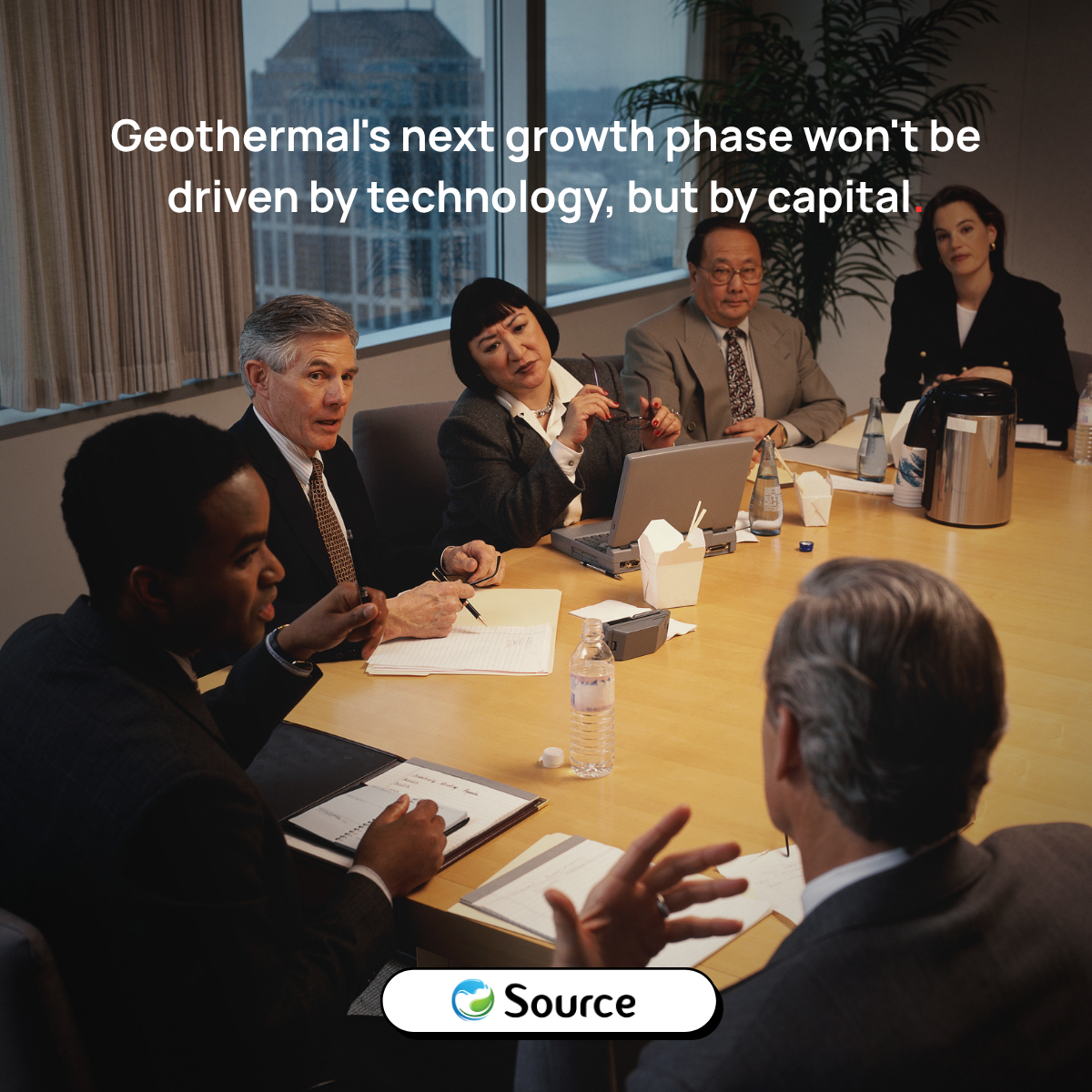
The question is whether capital markets will advance with it.
A recent article discussing superhot geothermal highlighted an important reality: many of the technical challenges facing the industry are solvable. Engineers continue to push deeper, hotter, and more productive geothermal systems. The challenge increasingly shifts from proving the resource to financing its development.
This is not unique to geothermal.
Large infrastructure projects often face a financing gap between early-stage development and long-term project financing. Investors may be interested in the opportunity, but many remain cautious about construction risk, resource validation, and long development timelines.
At Source Geothermal, we believe one of the most important opportunities for the industry is the development of new capital structures that better align investors with long-term infrastructure outcomes.
Traditional equity and debt financing will continue to play important roles. However, alternative financing mechanisms such as royalty-based structures may also help unlock growth by providing non-dilutive capital while aligning investors with future project performance.
Models such as those being developed by under royalty demonstrate how royalties can create additional pathways for infrastructure and energy projects to access capital without relying exclusively on conventional financing approaches. For developers, this can preserve ownership while creating greater flexibility during project development.
The geothermal sector does not have a technology problem.
It has a scale problem.
And scale ultimately requires capital.
As global demand for reliable power, industrial heat, and AI-driven data centre infrastructure continues to grow, geothermal’s next phase of growth may depend less on what happens underground and more on how effectively the industry attracts and structures investment above ground.
The future of geothermal will be built by engineers.
But it may be accelerated by financiers.