
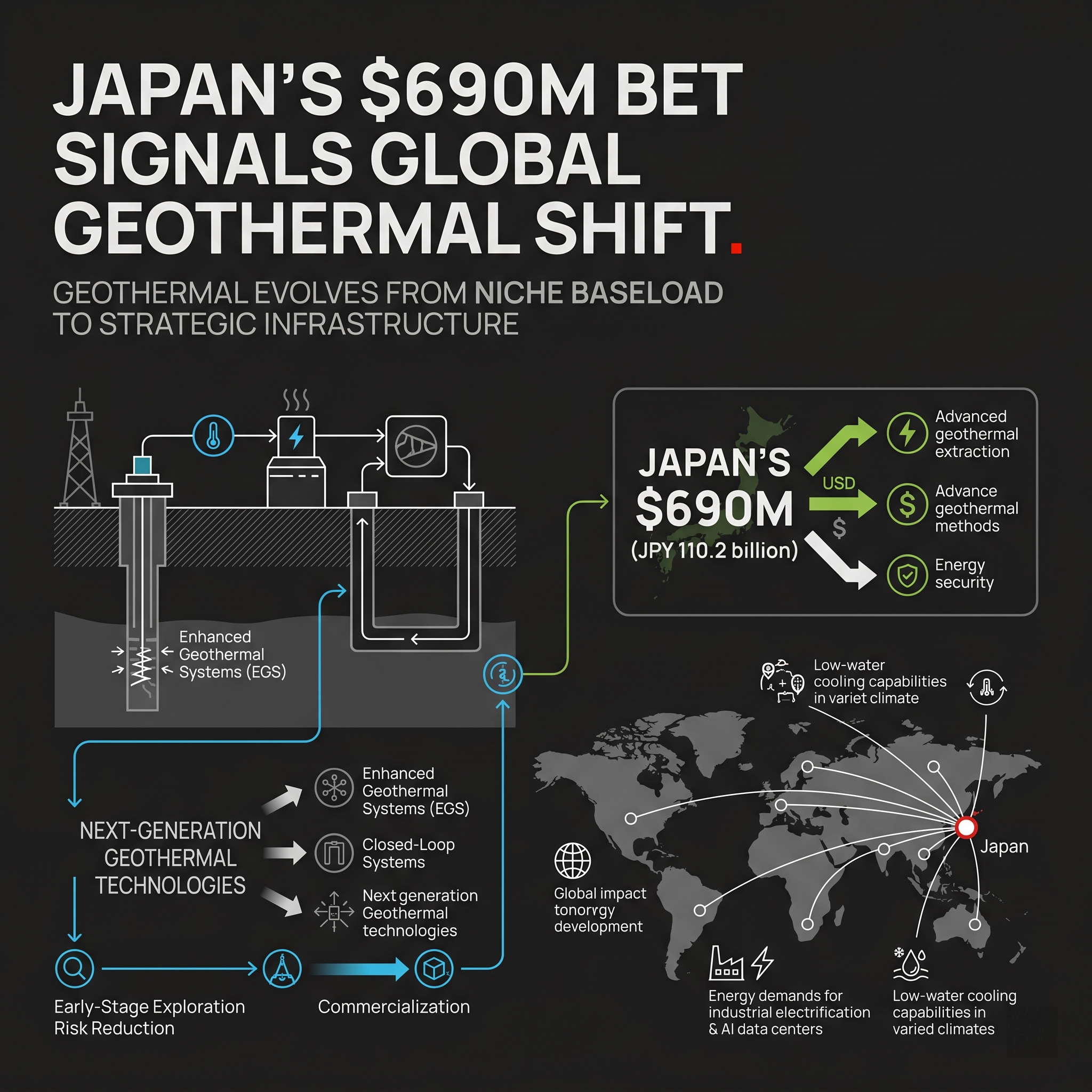
Japan has made a significant national commitment to next-generation geothermal technologies, allocating approximately $690 million USD (JPY 110.2 billion) through 2030 to accelerate the development of emerging geothermal systems. Announced by Japan’s Ministry of Economy, Trade and Industry (METI), the initiative is designed to support technologies such as enhanced geothermal systems (EGS), closed-loop geothermal, and supercritical geothermal—innovations that could dramatically expand geothermal deployment beyond traditional volcanic and hot spring regions.
For Source Geothermal, this is more than international energy policy—it is a signal that global governments are beginning to recognize geothermal as strategic infrastructure.
Japan’s subsidy framework reportedly covers up to two-thirds of eligible survey and test drilling costs, directly addressing one of the sector’s greatest barriers: early-stage exploration risk. By reducing upfront uncertainty, Japan is positioning itself to accelerate commercialization of geothermal technologies capable of serving future energy, industrial, and infrastructure needs.
The implications extend far beyond Japan.
As global energy demand rises—driven by AI data centres, industrial electrification, water scarcity, and national energy security—next-generation geothermal is increasingly being viewed not only as renewable power, but as a scalable thermal platform. Closed-loop systems and EGS, in particular, offer the potential for broader geographic deployment, lower environmental disruption, and integration into regions where water and cooling efficiency are becoming mission-critical.
This is especially relevant in markets facing extreme climate conditions, including parts of the Middle East, where reliable low-water cooling and stable energy supply are becoming essential to future economic development.
For Source Geothermal, Japan’s move reinforces a broader macro trend: geothermal is evolving from a niche baseload technology into a strategic pillar of next-generation infrastructure.
While solar, wind, and battery storage continue to dominate headlines, geothermal’s value proposition is becoming increasingly clear—reliable power, thermal resilience, and reduced water dependency.
Japan’s investment may prove to be more than a domestic energy initiative. It could represent a broader global shift toward recognizing next-generation geothermal as a critical component of energy security, industrial competitiveness, and the infrastructure demands of the AI era.